VoltWise — Because charging an EV shouldn’t feel like installing 15 different apps
If you own (or have tried to use) an electric vehicle, you’ve probably been through this:
👉 arrive at the charger
👉 open the wrong app
👉 download another app
👉 create an account
👉 verify email
👉 try again
👉 still doesn’t work
Congrats, you just used more phone battery than your car.
That’s basically what made me start VoltWise.
💡 The idea
VoltWise starts with a simple (and slightly ambitious) goal:
Unify the EV charging ecosystem.
Today, every charging station has:
- its own app
- its own backend
- its own API
- its own problems
The idea is to build an open-source platform that:
- helps small hotels and businesses offer charging
- provides a standardized backend
- offers a unified mobile app
- integrates with other systems in the future
Yes, it’s ambitious. But someone has to start.
🏗️ Architecture (aka: how I made things more complex on purpose)
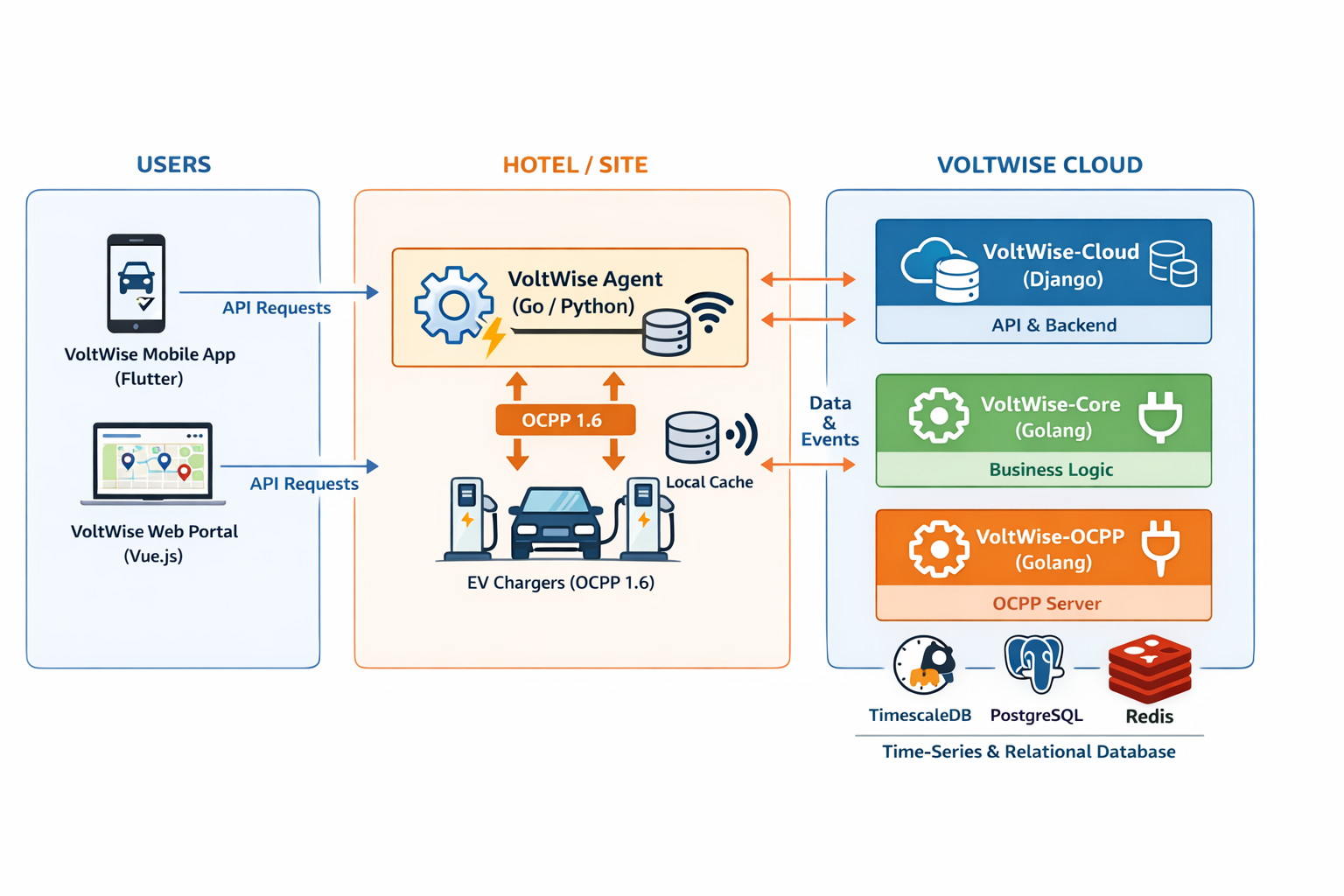
Overview of VoltWise architecture, including OCPP communication, local agent, and cloud.
The project is split into multiple modules:
- voltwise-core → shared business logic
- voltwise-ocpp → charger communication
- voltwise-cloud → central backend and API
- voltwise-agent → local software (hotel / site)
- voltwise-portal → web dashboard
- voltwise-mobile → user app
- voltwise-docs → documentation (because I try to be organized)
⚙️ Tech stack
A mix of experience, curiosity, and “I want to try this”.
Backend / Core
- Go (Golang)
- voltwise-core
- voltwise-ocpp
Why: performance and great concurrency for device communication.
Cloud / API
- Django + Django REST Framework
Why: fast development and a very mature ecosystem.
Mobile
- Flutter
Why: single codebase for Android and iOS.
Web Portal
- Vue.js
Why: clean, simple, and efficient.
Local Agent
Still undecided 🤔
Options:
- Go (very likely)
- Python
- maybe Flutter Desktop
🔌 OCPP (the important part)
The project will use:
- OCPP 1.6
This is basically the language chargers speak.
Without it → nothing works
With it → things should work 😅
🌍 Future vision
This is not just another project.
It’s an attempt to solve a real problem:
today you need a different app for every charging network.
In the future, VoltWise could:
- integrate with other platforms
- enable roaming between networks
- unify payments
- become an open charging hub
And of course…
👉 maybe turn into a SaaS (because open source doesn’t pay for coffee).
🚀 Why I’m building this
- technical challenge
- learning IoT and OCPP
- building something actually useful
- improving my portfolio
- and because it sounded like a great idea at 2AM
📌 Next steps
- structure repositories
- start core in Go
- implement basic OCPP (with WebSocket and basic auth)
- build Django backend (and connect to Vue.js Portal)
- document everything
- integrate local Agent with the Cloud
- finish and launch the Mobile App
If you made it this far, you’re already more involved than most people 😄
I’ll keep documenting everything here.